If you have ever opened a budgeting app, stared down 40 spending categories, and closed it five minutes later out of sheer overwhelm, the 50/30/20 budget rule was built for you. It is not the most precise budgeting method out there, but it’s the one people actually stick with and a budget you follow beats a “perfect” one you abandon in two weeks.
What the 50/30/20 Budget Rule Actually Says
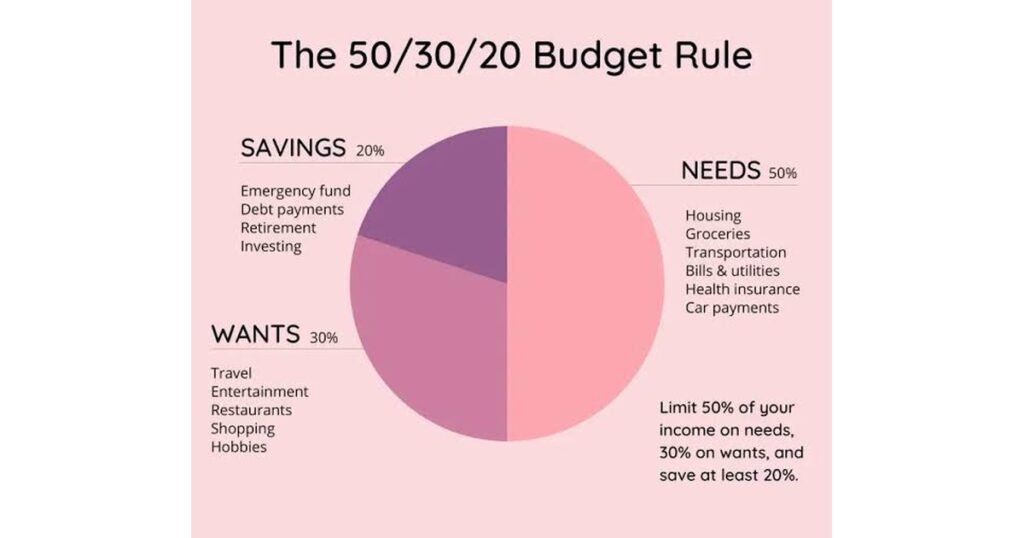
Popularized by Senator Elizabeth Warren in All Your Worth, the 50/30/20 rule splits your after-tax income into three buckets:
- 50% → Needs : things you must pay to live and work
- 30% → Wants : things that improve your life but aren’t essential
- 20% → Savings & Debt Payoff : building your future and getting out of debt faster than the minimum requires
That’s the entire framework. No 40 categories, no daily expense logging just three buckets and a percentage.
Breaking Down Each Bucket of the 50/30/20 Budget Rule
50% Needs
This is anything you had still have to pay even if your income dropped tomorrow:
- Rent or mortgage
- Utilities (electricity, water, gas, internet)
- Groceries (not takeout actual grocery-store food)
- Minimum debt payments
- Insurance premiums
- Transportation needed for work (car payment, gas, transit pass)
- Childcare, if it’s required for you to work
Reality check: In many cities, housing alone can eat 35–40% of income, which pushes total “needs” past 50%. If that’s your situation, do not panic it just means your “wants” bucket has to shrink to compensate, or you need to revisit the 20% savings split below for a temporary adjustment.
30% — Wants
Anything that makes life more enjoyable but you could technically live without:
- Dining out and takeout
- Streaming subscriptions
- Hobbies, gym memberships, entertainment
- Vacations and travel
- Non-essential shopping (clothes beyond basic need, gadgets, upgrades)
This is the bucket people tend to underestimate the $6 coffee, $15 lunch delivery fee, and $12/month app subscriptions add up faster than they feel like they do in the moment.
20% Savings & Extra Debt Payments
This bucket covers your future self:
- Emergency fund contributions
- Retirement account contributions (401k, IRA, or your country’s equivalent)
- Extra payments beyond the minimum on debt
- General savings goals a house down payment, a car, education
If you’re carrying high-interest debt (think credit cards above ~15–20% APR), it’s reasonable to temporarily lean this whole 20% toward payoff instead of splitting it with savings paying down a 24% APR card is effectively a guaranteed 24% “return.” For a deeper look at prioritizing that payoff, SavingsBeat’s debt payoff guide breaks down how to sequence it.
Worked Example: $4,000/Month After-Tax Income
| Bucket | Percentage | Dollar Amount |
| Needs | 50% | $2,000 |
| Wants | 30% | $1,200 |
| Savings/Debt | 20% | $800 |
If this person’s actual rent, utilities, groceries, insurance, and minimum debt payments only total $1,700, they have $300 of slack they can shift toward savings or wants the rule adapts to real numbers, it is not a rigid law.
What If Your Numbers Do not Fit the 50/30/20 Ratios?
They often wo not, especially in high cost-of-living areas or if you are early in your career. Here’s how to adjust without abandoning the framework entirely:
- Needs consistently above 50%? Try a temporary 60/20/20 split instead, and look for ways to reduce fixed costs (roommate, refinancing, negotiating bills) over time rather than permanently squeezing your savings rate to zero.
- No debt and a healthy income? Consider flipping to 50/20/30, pushing more into savings/investing while wants stay modest especially powerful in your 20s and 30s when compounding has the most time to work.
- Irregular income (freelance, commission)? Apply the percentages to your average monthly income over the last 6–12 months, not to a single good or bad month.
How to Actually Set Up the 50/30/20 Budget (Not Just Know About It)
- Calculate your true after-tax monthly income the number that hits your bank account, not your gross salary.
- Track last month’s actual spending for one pass, sorted into the three buckets. Most banking apps can auto-categorize this.
- Compare it to the 50/30/20 targets and see where the gap is usually it’s the “wants” bucket that’s running hot.
- Automate the savings bucket first. Set up an automatic transfer for your 20% the day you get paid, before you have a chance to spend it. This single habit does more than any spreadsheet.
- Use separate accounts or sub-accounts for needs, wants, and savings if your bank supports it physically separating the money reduces the temptation to blur the lines.
- Revisit every 3–6 months, especially after a raise, a move, or a new financial goal.
Want to skip the manual math? SavingsBeat’s Budget Calculator lets you plug in your after-tax income and see the three buckets broken out instantly.
Common Mistakes to Avoid With the 50/30/20 Rule
- Counting debt minimums as “wants.” They’re needs missing them damages your credit and often triggers fees or higher rates.
- Treating the 20% as optional. It’s the bucket most people cut first when money feels tight, but it’s the one building your actual financial security.
- Forgetting irregular expenses. Annual costs like car registration, holiday gifts, or insurance premiums paid yearly should be divided by 12 and folded into your monthly “needs” or “wants” calculation, not treated as surprises. The Consumer Financial Protection Bureau’s budgeting worksheet walks through this kind of annualized planning in more detail.
The Bottom Line
The 50/30/20 rule is not magic it is a starting framework simple enough to actually follow. Calculate your after-tax income, sort last month’s spending into the three buckets, automate your savings percentage first, and adjust the ratios to fit your real cost of living rather than forcing your life into someone else’s percentages.
This article is for educational purposes only and does not constitute financial advice. Consult a licensed financial advisor for guidance specific to your situation.