✅ All calculators are 100% free — No sign-up, no hidden charges Try Free Tools →
Skip to main content

Free Financial Calculators | Savings Beat

If you are staring down credit card balances, a car loan, and maybe a personal loan on top of everything else, chances are you have already typed “how to pay off debt fast” into Google and landed on two competing answers: the debt avalanche and the debt snowball.

Both of these actually work. Neither one is a scam or some influencer gimmick. The real difference is that they are built to optimize for two very different things one for the math, one for your motivation. And picking the wrong one for your personality is a quiet way to sabotage progress you’ve already made.

Here’s how each method actually works, what the numbers look like, and how to figure out which one fits you.

The Core Idea Behind Both Methods

Both strategies start the exact same way:

  1. List every debt you owe balance, interest rate, and minimum payment.
  2. Keep making minimum payments on all of them, no exceptions.
  3. Throw every extra dollar you can scrape together at one debt at a time.
  4. Once that debt is gone, roll its entire payment into the next one on your list.

The only place they split is which debt you go after first.

Method 1: The Debt Avalanche (Interest-Rate Order)

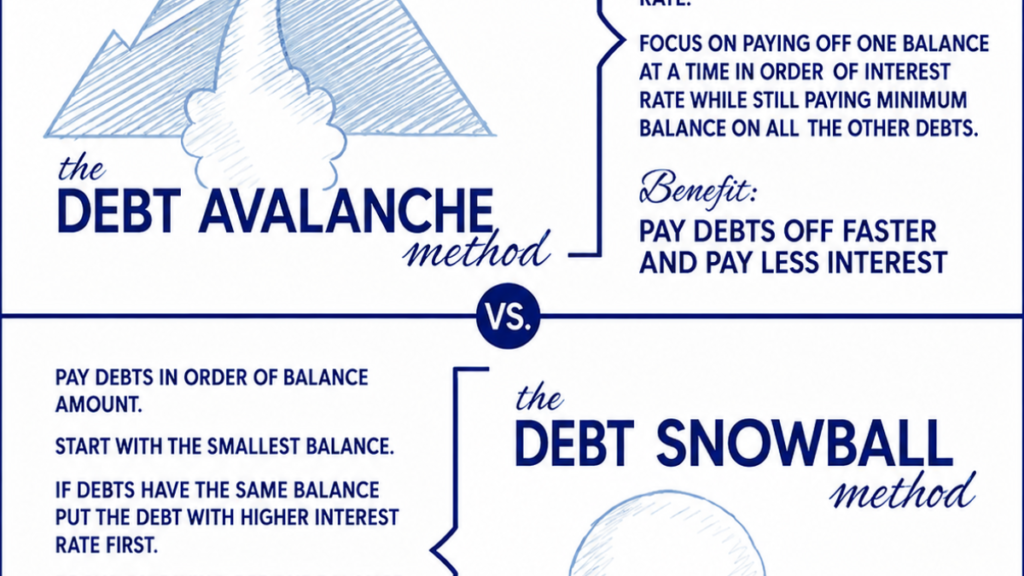
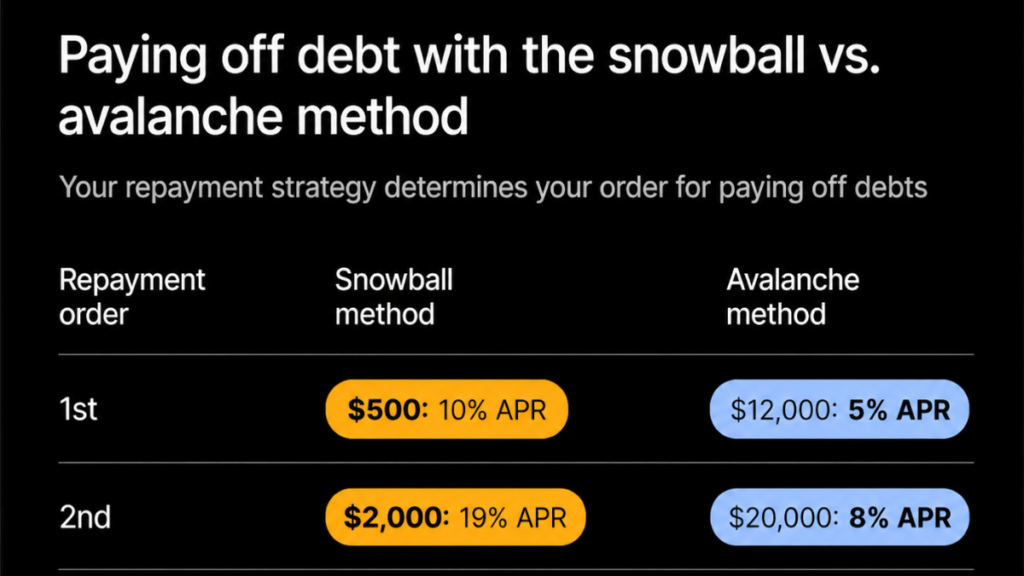
With the avalanche method, you rank your debts by interest rate highest to lowest and ignore the balance size completely. Every spare dollar goes to whichever debt has the highest rate, since that’s the one bleeding you the most every single month it stays alive.

Example:

  • Credit Card A: $4,000 at 24% APR
  • Credit Card B: $1,500 at 19% APR
  • Car Loan: $9,000 at 6% APR

Avalanche order: Credit Card A → Credit Card B → Car Loan.

Why it wins on paper: Interest is basically a silent tax on debt. A card sitting at 24% APR is actively working against you, while a 6% car loan barely moves the needle. Kill the most expensive debt first and you cut down the total interest you’ll pay over the whole payoff plan sometimes by hundreds or thousands of dollars, depending on how spread out your rates are.

The catch: Your highest-rate debt isn’t always your smallest one. So your first real “win” could take months to show up, and long stretches without a visible result are exactly when most people give up.

Method 2: The Debt Snowball (Balance Order)

The snowball method made popular by a well-known personal finance personality throws interest rates out the window entirely. Instead, you rank debts from smallest balance to largest and attack the smallest one first.

Same example, snowball order: Credit Card B ($1,500) → Credit Card A ($4,000) → Car Loan ($9,000)

Why it works psychologically: Paying off debt is a marathon, and marathons get won by the people who don’t quit around month three. Wiping out an entire balance, even a small one, gives you something real to point to. That first win builds momentum, and momentum is what keeps people showing up long after a spreadsheet full of math has stopped feeling motivating.

The catch: You could end up paying more in total interest, since a low-balance, low-rate debt might jump the line ahead of a high-balance, high-rate one that’s actually costing you more.

The Numbers: What Does the “Wrong” Choice Actually Cost You?

Using the example above, and assuming an extra $300/month gets thrown at debt on top of minimums:

MethodTotal Interest PaidTime to Debt-Free
Avalanche~$1,180~19 months
Snowball~$1,340~19 months

That’s roughly a $160 gap noticeable, but not exactly life-changing. Where it starts to matter more is when the interest-rate spread between your debts widens, say a 29% store card sitting next to a 4% student loan. The bigger that gap, the harder the avalanche method pulls ahead financially.

If you want to see this play out with your own numbers instead of a hypothetical, SavingsBeat’s debt payoff calculator will run both methods side by side so you know exactly what you’re trading off before you commit.

So Which One Should You Actually Pick?

Ask yourself one honest question: Have I started and abandoned a debt payoff plan before?

  • If yes, and you know you need quick wins to stay in the game, go with the snowball. A method you actually finish beats a theoretically perfect one you quit on in month four.
  • If no, and you can hold out for a bigger payoff without an early win, the avalanche will save you more in interest.
  • If your rate gap is huge (think a 25%+ credit card next to a 5% loan), lean avalanche even if you’re not naturally disciplined the interest savings get too big to ignore.
  • Want both? Try the hybrid approach: clear anything under $500 first for a quick psychological win, then switch to strict avalanche order for the rest.

A Third Option Worth Considering: Debt Consolidation

If you’re juggling several high-interest debts, it’s worth checking whether a balance transfer card (often 0% intro APR for 12–18 months) or a personal consolidation loan at a lower fixed rate could sidestep the avalanche-vs-snowball decision altogether. NerdWallet’s debt consolidation guide is a solid place to compare typical rates, fees, and eligibility requirements before you apply anywhere.

Consolidation isn’t for everyone it comes down to your credit score and the fees attached but done right, it can turn several payments into one and meaningfully lower your effective interest rate.

Practical Steps to Start This Week

  1. List every debt in a spreadsheet: balance, APR, minimum payment, due date.
  2. Work out your “extra” amount whatever you can realistically commit above minimums each month.
  3. Pick avalanche, snowball, or hybrid based on the question above.
  4. Automate every minimum payment so nothing slips through the cracks (a missed payment can wreck your credit score and trigger a penalty APR).
  5. Recheck the numbers every 3 months as balances shrink and income changes, your “extra” amount should grow too.

Want a template instead of building one from scratch? SavingsBeat’s free debt tracker already has this structure built in, so you can plug in your numbers and start today.

The Bottom Line

There’s no universally “correct” answer between avalanche and snowball there is only the method you’ll actually stick with until you hit zero. Avalanche saves more money on paper. Snowball keeps more people in the game long enough to finish. Pick whichever one matches how you’re actually wired, run your real numbers, and start with whatever amount you can commit to today. Progress compounds just like interest does it just needs that first payment to get moving.

This article is for educational purposes only and does not constitute financial advice. Consult a licensed financial advisor for guidance specific to your situation.

If you’re carrying credit card balances, a car loan, and maybe a personal loan on top of everything else, you are probably already searched “how to pay off debt fast” and landed on two competing answers: the debt avalanche and the debt snowball. Both work. Neither is a scam or a gimmick. But they optimize for two different things math and motivation and picking the wrong one for your personality can quietly sabotage your progress.

This guide breaks down exactly how each method works, the real numbers behind them, and how to decide which one fits you.

The Core Idea Behind Both Methods

Both strategies start the same way:

  1. List every debt you owe balance, interest rate, and minimum payment.
  2. Keep making minimum payments on all of them.
  3. Throw every extra dollar you can find at one debt at a time.
  4. Once that debt is gone, roll its entire payment into the next one on your list.

The only difference is which debt you attack first.

Method 1: The Debt Avalanche (Interest-Rate Order)

With the avalanche method, you rank your debts from highest interest rate to lowest, regardless of balance size. You put every spare dollar toward the highest-rate debt first, since that’s the one costing you the most money every month it survives.

Example:

  • Credit Card A: $4,000 at 24% APR
  • Credit Card B: $1,500 at 19% APR
  • Car Loan: $9,000 at 6% APR

Avalanche order: Credit Card A → Credit Card B → Car Loan.

Why it wins mathematically: Interest is the silent tax on debt. A 24% APR card is actively growing while a 6% car loan barely moves. By killing the most expensive debt first, you minimize the total interest you pay over the life of your payoff plan often by hundreds or even thousands of dollars compared to other orderings.

The catch: The highest-interest debt isn’t always the smallest one. That means your first “win” might take months to arrive, and long waits before a visible result are exactly when people quit.

Method 2: The Debt Snowball (Balance Order)

The snowball method, popularized by finance personality Dave Ramsey, ignores interest rates completely and instead ranks debts from smallest balance to largest. You throw every spare dollar at the smallest debt first.

Same example, snowball order: Credit Card B ($1,500) → Credit Card A ($4,000) → Car Loan ($9,000)

Why it works psychologically: Debt payoff is a marathon, and marathons are won by people who don’t quit in month three. Wiping out a full balance even a small one gives you a real, visible win fast. That momentum (the “snowball” rolling downhill and picking up size) keeps people engaged far longer than a pure math argument does.

The catch: You may pay more in total interest over time, because a low-balance, low-rate debt could get prioritized over a high-balance, high-rate one.

The Numbers: How Much Does the “Wrong” Choice Actually Cost?

Using the example above, with an extra $300/month put toward debt on top of minimums:

MethodTotal Interest PaidTime to Debt-Free
Avalanche~$1,180~19 months
Snowball~$1,340~19 months

The difference here is roughly $160 noticeable, but not life-changing. The gap grows larger as the interest-rate spread between your debts widens (for example, if you’re comparing a 29% store card against a 4% student loan). The bigger the rate gap, the more the avalanche method pulls ahead financially.

So Which One Should You Pick?

Ask yourself one honest question: Have I started and abandoned a debt payoff plan before?

  • If yes, and you know you need quick wins to stay motivated, use the snowball. A method you actually stick with beats a theoretically optimal one you quit on in month four.
  • If no, and you’re disciplined enough to wait for a bigger payoff without an early win, use the avalanche and save more money in interest.
  • If your rate gap is huge (think 25%+ credit card vs. 5% loan), lean avalanche even if you’re not naturally disciplined the interest savings are too large to ignore.
  • If you want the best of both, try the hybrid approach: knock out any debt under $500 first for a quick psychological win, then switch to strict avalanche order for everything else.

A Third Option: Debt Consolidation

If you have multiple high-interest debts, it’s worth checking whether a balance transfer card (often with 0% intro APR for 12–18 months) or a personal consolidation loan at a lower fixed rate could replace the avalanche/snowball decision entirely. Consolidation won’t work for everyone it depends on your credit score and the fees involved but it can simplify multiple payments into one and cut your effective interest rate dramatically.

Practical Steps to Start This Week

  1. List every debt in a spreadsheet: balance, APR, minimum payment, due date.
  2. Calculate your “extra” amount anything above minimums you can realistically commit each month.
  3. Pick avalanche, snowball, or hybrid based on the question above.
  4. Automate minimum payments on everything so nothing is ever missed (missed payments wreck your credit score and often trigger penalty APRs).
  5. Recalculate every 3 months as balances shrink and your income changes, your “extra” amount should grow too.

The Bottom Line

There’s no universally “correct” answer between avalanche and snowball there’s only the method you’ll actually follow through to zero. The avalanche method saves more money on paper. The snowball method keeps more people in the game long enough to finish. Pick the one that matches how you’re wired, run the numbers with our EMI and savings calculators to see your own timeline, and start with whatever amount you can commit today. Progress compounds just like interest does it just takes the first payment to get moving.

This article is for educational purposes only and does not constitute financial advice. Consult a licensed financial advisor for guidance specific to your situation.

Leave a Reply

Your email address will not be published. Required fields are marked *

© 2026 SavingsBeat.online — All rights reserved.

⚠️ Disclaimer: All calculators and content on Savings Beat are provided for educational and informational purposes only. Results are estimates and do not constitute professional financial, legal, or investment advice. Always consult a qualified financial advisor before making major financial decisions. Savings Beat is not a bank or regulated financial service.