
A coast fire calculator tells you one specific number. It shows how much you need invested today so compound growth alone carries you to a full retirement fund by your target age. You add zero new dollars after that point. This matters because most savings advice never tells you when you can actually stop.
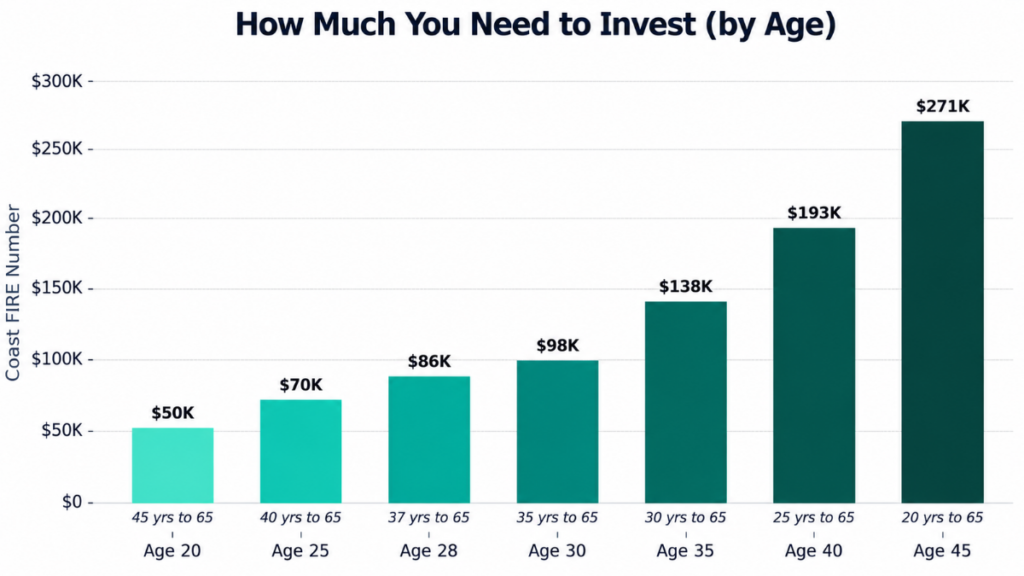
Here is how the math works with real numbers. Say you are 30 years old, plan to retire at 65, and expect to spend $40,000 a year in retirement. Using the standard 25x rule, your full FIRE number is $1,000,000. Assuming a 7% average annual return over those 35 years, you would need $93,650 invested right now. Nothing more. That single amount grows on its own into $1 million by age 65, based on projections used by tools like ProjectionLab.

What Coast FIRE Actually Means
Coast FIRE is a financial independence milestone. You reach it when your current investments, left alone, will grow into your full retirement number by a set age. You still work after hitting this point. You just stop needing to save for retirement.
That second part is the real shift. Once you coast, every dollar you would have saved becomes optional. You can take a lower-paying job you enjoy more. You can cut hours. You can switch careers without wrecking your retirement timeline. The pressure comes off because compound growth is already doing the heavy lifting.
This differs from full FIRE, where your portfolio already supports your spending today. It also differs from Barista FIRE, where you work part-time specifically to cover health insurance or living costs while your investments keep growing untouched. Coast FIRE sits earlier in the journey. It is a checkpoint, not a finish line.
The Coast FIRE Formula
The formula behind a coast fire calculator has two parts. First, find your FIRE number: annual retirement spending multiplied by 25. This comes from the 4% rule, a withdrawal guideline built on the 1998 Trinity Study.
Second, discount that number back to today using your investment return and years remaining. The formula looks like this: Coast FI Number = FIRE Number ÷ (1 + annual return)^years until retirement. A calculator automates this, but knowing the formula helps you sanity-check any tool you use.
Your return assumption changes the result significantly. Most planners use 6% to 7% nominal returns for stock-heavy portfolios, based on long-term historical averages tracked by sources like the Federal Reserve. Conservative planners drop that to 5% for extra safety margin.
Why Your Retirement Age Changes Everything
Years remaining until retirement is the most powerful variable in this formula. More years means more time for compounding, which means you need less money today. Fewer years means less runway, so your coast number climbs fast.
Compare two people spending the same $40,000 a year in retirement. A 25-year-old targeting age 65 has 40 years of growth ahead. A 45-year-old targeting the same age has only 20 years. The 25-year-old needs roughly $66,780 invested today at 7% growth. The 45-year-old needs about $258,420 for the identical outcome.
That gap is not a rounding difference. It shows why starting early carries more weight than almost any other factor in this calculation. Time does more work than contribution size ever can.
What to Plug Into a Coast FIRE Calculator
A working calculator needs five inputs to give you an accurate number. Skipping any of them produces a misleading result, so treat each one seriously before you trust the output.
- Current age and target retirement age. This sets your compounding runway.
- Annual spending in retirement. Use real expenses, not a guess.
- Current invested assets. Include 401(k), IRA, and brokerage accounts meant for retirement.
- Expected annual return. Stay realistic, typically 5% to 7% real return.
- Withdrawal rate. The standard is 4%, though some planners use 3.5% for extra safety.
Once you know your current invested total, compare it against your coast number using a net worth calculator to see how close you already are. If a gap remains, a compound interest calculator shows exactly how added monthly contributions close that distance faster.
What Most Coast FIRE Articles Miss
Almost every coast fire explainer stops at the formula. Few mention that your coast number is not static. It moves every year, and not always in the direction you expect.
If markets have a strong year, your existing portfolio might already exceed your coast number before you planned. That means you can scale back contributions sooner than your original timeline suggested. Run the numbers annually, not once and forget it. Treat coast FIRE as a moving target you check yearly, the same way you would review a retirement calculator projection after a raise or a market shift.
The other overlooked piece is healthcare. Coasting often means switching to lower-income or part-time work, which can mean losing employer health coverage. Factor that cost into your annual spending estimate before you decide you have truly hit your number. A coast number that ignores healthcare premiums understates what you actually need.
Coast FIRE for Couples
Calculating coast FIRE gets more complex with two people. You need combined retirement spending, two possible Social Security timelines, and potentially different target retirement ages if one partner wants to stop working sooner.
The cleanest approach is running the numbers as a household rather than doubling an individual formula. Combine your total invested assets, agree on one shared annual spending figure, and use the later of your two target retirement ages for the discounting calculation. This avoids overstating how much you actually need.
Common Mistakes When Using a Coast FIRE Calculator
Three mistakes show up constantly in coast FIRE planning. Watch for each one before you commit to a number.
- Using today’s spending instead of retirement spending. Your costs will shift, especially around housing and dependents.
- Ignoring inflation. A $40,000 lifestyle today costs more in 30 years unless your return assumption is already inflation-adjusted.
- Overestimating investment returns. A 10% assumption looks appealing but rarely holds up over long stretches, according to guidance from the Consumer Financial Protection Bureau on realistic retirement planning.
Fixing these three issues alone makes most coast FIRE projections far more trustworthy.
The Bottom Line
A coast fire calculator gives you a specific, useful answer: the exact amount you need invested today so compound growth finishes the job by your target retirement age. The formula is simple, but the inputs matter more than the math itself. Get your spending, return assumption, and timeline right, and you get a number worth planning around. Once you hit it, saving for retirement becomes optional, not required, and every dollar after that is yours to spend, invest further, or use to work less.