A CD interest calculator shows you the exact dollar amount your certificate of deposit will earn before you lock your money away. That matters right now. The best CD rates in August 2026 sit between 4.00% and 5.00% APY, while the national average is closer to 2%.
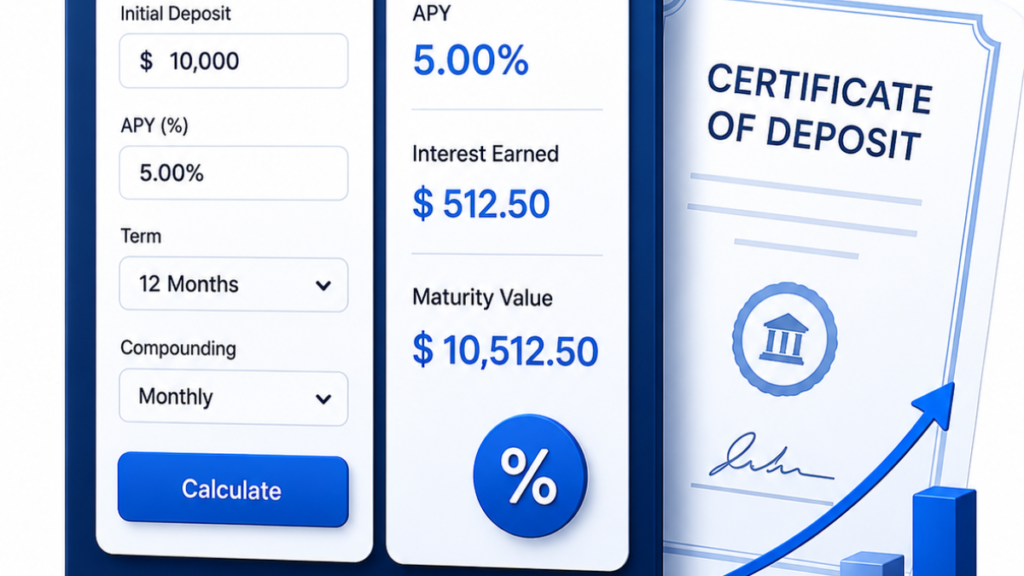
Put $10,000 into a 12-month CD paying 4.50% APY, compounded monthly, and it grows to about $10,459 at maturity. That is $459 in interest for locking your cash away for one year. A CD interest calculator does this math instantly, so you never have to guess whether a bank’s advertised rate is actually worth the trade-off.
Most people skip this step. They see a rate, assume it sounds good, and open the account. But a CD interest calculator forces you to compare the real return against what you would earn elsewhere, like a high-yield savings account or a compound interest calculator result on a different product entirely.
What a CD Interest Calculator Actually Does
A CD interest calculator takes three inputs. You enter your deposit amount, your APY, and your term length in months or years. It then applies compound interest math to show your ending balance and total interest earned.
This differs from a simple interest formula. Banks compound CD interest daily, monthly, or quarterly, not once a year. That compounding frequency changes your actual return, even when two CDs advertise the same headline rate. A good calculator accounts for this automatically.
You should also see a breakdown by month or year. This helps you plan around real dates, like a tuition payment or a home down payment, instead of guessing when your CD will reach a specific value.
Today’s CD Rates: What to Expect in 2026
CD rates cooled off from their 2023 highs but remain well above where they sat a few years ago. As of mid-August 2026, top online banks and credit unions offer between 4.00% and 4.50% APY on one-year CDs, according to Bankrate’s tracked data. Some short-term specials still reach above 5.00% at select institutions.
The gap between top rates and national averages is unusually wide. The FDIC lists the national average one-year CD rate at just 1.68%, meaning savers who shop around earn nearly three times more than those who stick with their home bank. A CD interest calculator makes that gap concrete instead of abstract.
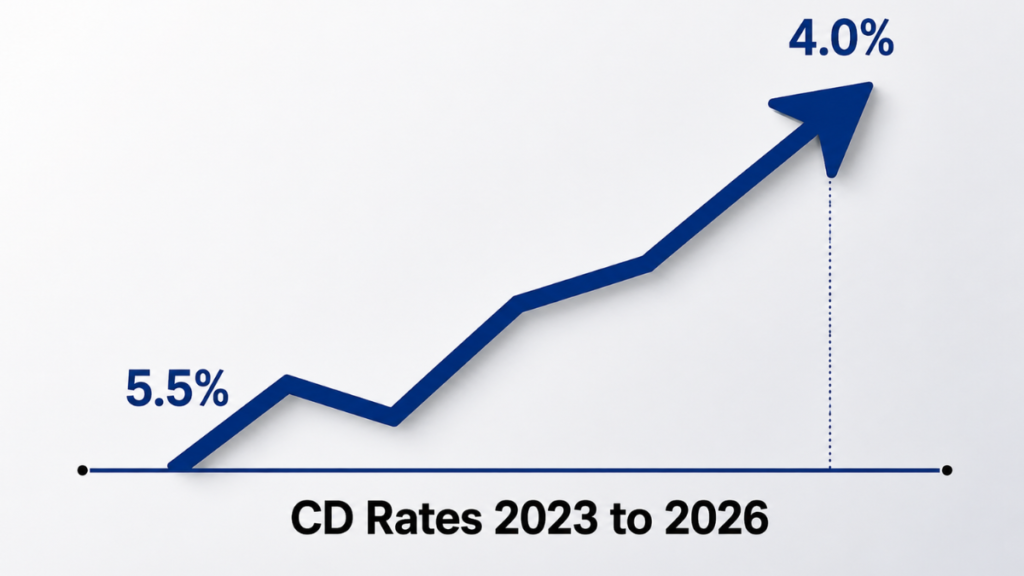
The Federal Reserve cut rates three times in late 2025 and has held steady through most of 2026. Banks typically follow the Fed’s direction with a delay, which is why online banks still advertise competitive CD rates even as savings account yields drift lower. If you are also tracking a shorter-term goal, a savings calculator can show how a high-yield account stacks up against a fixed-term CD over the same period.
APY vs Interest Rate: Why the Difference Matters
Banks advertise APY, not a plain interest rate, and the difference affects your actual earnings. APY already includes the effect of compounding over one year. A plain interest rate does not.
Two CDs can list the same 4.5% number, yet one compounds daily and the other compounds monthly. The daily version earns you slightly more by maturity. A CD interest calculator that lets you set compounding frequency shows this difference in real dollars, not just percentages.
Always confirm which figure a bank is quoting before you compare offers. The Consumer Financial Protection Bureau notes that APY is the standard measure for comparing deposit accounts fairly, since it reflects true annual earnings rather than a nominal rate that undersells the real return.
How Term Length Changes Your Total Interest
Longer CD terms do not always mean higher rates in 2026. Right now, one-year CDs often out-earn five-year CDs at the same bank, a pattern called an inverted yield curve. This is a direct result of the Fed holding rates steady while banks expect future cuts.
Run both terms through a CD interest calculator before you commit. A $10,000 deposit at 4.30% for one year earns roughly $439. The same deposit at 3.80% for five years, a rate common on longer CDs right now, earns about $2,051 total, or roughly $410 per year on average. Shorter terms currently offer better annual value for most savers.
This is the kind of detail a headline rate alone will never show you. It only becomes visible once you calculate the actual dollar return across each term length.
Early Withdrawal Penalties and Your Real Return
A CD locks your money for a fixed term. Pull it out early, and the bank charges a penalty, usually equal to a set number of months’ worth of interest. Terms under a year often carry a 90-day interest penalty. Terms of one to three years often carry a 180-day penalty.
This penalty can erase most or all of your earned interest if you withdraw close to the start of the term. Before opening a CD, confirm you will not need that cash before maturity. If there is any doubt, a no-penalty CD or a high-yield savings account is a safer fit, even at a slightly lower rate.
CD Interest Calculator vs Long-Term Planning Tools
A CD interest calculator answers a narrow question: what will this specific deposit earn by this specific date. It is not built for multi-decade planning. If you are mapping out retirement savings or long-term compound growth, a retirement calculator handles that timeline more accurately, since it accounts for regular contributions and inflation over many years.
Use the CD tool for what it does best: locking in a known return over months or a few years. Use longer-horizon tools when the question shifts from “what does this deposit earn” to “will I have enough by a certain age.”
How to Use a CD Interest Calculator the Right Way
Start with your actual deposit amount, not a rounded guess. Small differences in principal change your total return more than most people expect over multi-year terms. Enter the exact APY listed on the bank’s rate page, not a rate you remember from a past visit.
Test more than one term length before you decide. Run the same deposit through a six-month, one-year, and two-year scenario to see which one actually earns more per year, not just more in total. Compare that result against a savings account or money market rate for the same period, since some accounts now rival CD rates without the lockup.
Finally, factor in the early withdrawal penalty as a real cost, not a footnote. Subtract it from your projected earnings if there is any chance you will need the funds early. This gives you a true worst-case number, not just an optimistic best-case one.
The Bottom Line
A CD interest calculator turns a bank’s advertised rate into an actual dollar figure you can plan around. In 2026, the gap between top CD rates near 4.50% and national averages near 1.68% is wide enough that shopping around matters more than usual. Run your numbers before you lock in a term, compare it against shorter and longer options, and factor in the withdrawal penalty as a real cost. That is how you turn a CD from a guess into a calculated decision.