A break even calculator shows you the exact number of units or sales dollars you need to cover all your costs. Below that number, you lose money. Above it, you start earning profit. Every small business owner should know this number before setting prices or spending on marketing.
Here is how the math works. Say your fixed costs are $5,000 a month, your product sells for $50, and it costs you $30 to make each one. Your contribution margin is $20 per unit. Divide $5,000 by $20, and you need to sell 250 units a month to break even. Sell fewer, and you lose money. Sell more, and every extra unit adds pure profit.
What the Break Even Point Actually Measures
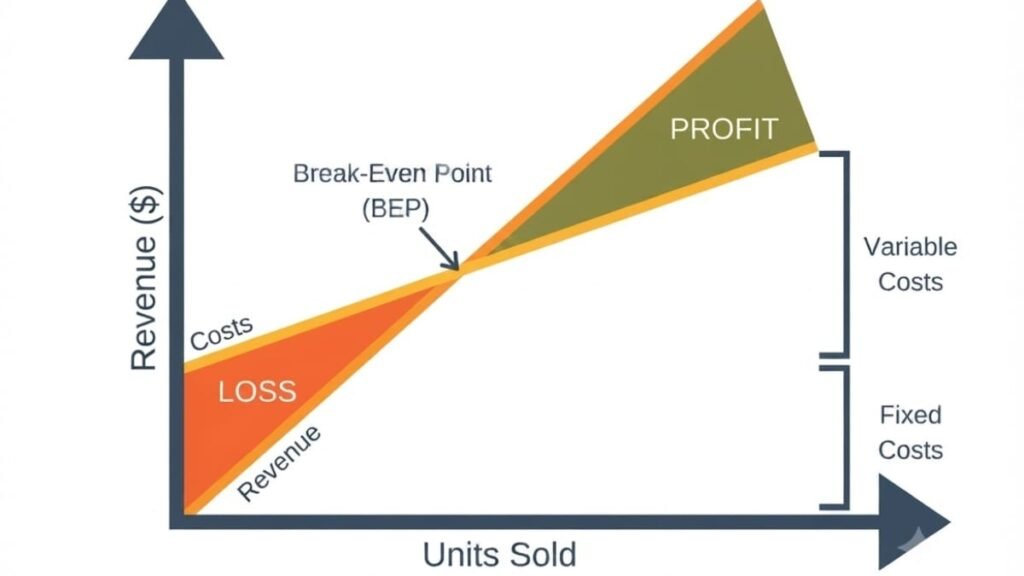
The break even point is the sales level where total revenue equals total costs. At that point, your profit is zero. It is not a target. It is a floor. Everything you sell above that floor moves straight into profit, assuming your cost structure stays the same.
This number changes the moment your costs or prices change. Raise your price, and you need fewer sales to break even. Add a new fixed cost, like a bigger office lease, and you need more sales to cover it. Smart owners recalculate their break even point every time something in the business shifts.
Many owners confuse break even with profitability. They are not the same thing. A business can hit its break even point every month and still fail, because break even means zero profit, not healthy profit. You want a sales target well above break even, not right at it.
The Break Even Formula, Explained Simply
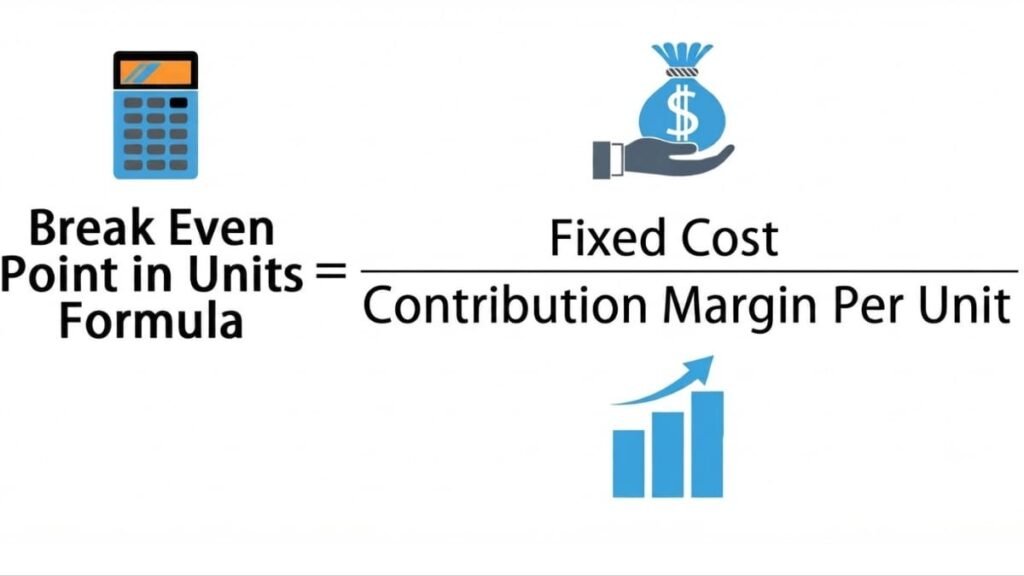
The formula has three parts: fixed costs, price per unit, and variable cost per unit. Fixed costs stay the same no matter how much you sell, like rent, salaries, and insurance. Variable costs change with each sale, like materials and shipping. Subtract variable cost from price to get your contribution margin.
Break Even Point (units) = Fixed Costs ÷ (Price per Unit − Variable Cost per Unit)
Once you have your break even point in units, multiply it by your price to get your break even point in dollars. Using the earlier example, 250 units at $50 each equals $12,500 in monthly revenue to break even. That figure is often more useful for owners who think in revenue targets rather than unit counts.
Why Fixed and Variable Costs Matter So Much
Getting your break even number right depends entirely on sorting your costs correctly. Rent, software subscriptions, and salaried staff are fixed. Raw materials, packaging, and payment processing fees are variable. Mixing these up throws off your entire calculation and gives you a false sense of safety.
Some costs are semi-variable, meaning they have a fixed base plus a variable component. A phone plan with a base fee plus per-minute charges is one example. For break even purposes, split these into their fixed and variable parts before running the numbers. Skipping this step is a common mistake among first-time business owners.
The Small Business Administration recommends reviewing your cost structure regularly, since suppliers change prices and rent increases over time (https://www.sba.gov). A break even number calculated once and never updated becomes useless within a year. Treat this as a living number, not a one-time exercise.
Break Even Analysis for Service Businesses
Service businesses can use the same formula, but they measure in billable hours instead of units. Replace “price per unit” with your hourly rate, and replace “variable cost per unit” with any direct cost tied to delivering that hour, like contractor fees or software licensing per client.
A freelance consultant charging $100 an hour with $3,000 in monthly fixed costs and $10 in variable costs per billable hour needs 33 billable hours a month to break even. That is a useful number for planning how many clients to take on. It also shows why raising your rate, even slightly, lowers the hours you need to hit that floor.
How to Lower Your Break Even Point
Three levers move your break even point: raise prices, cut fixed costs, or reduce variable costs per unit. Raising prices has the fastest impact, since it increases your contribution margin on every single sale without changing your cost structure at all.
Cutting fixed costs, like renegotiating rent or switching software plans, lowers the total amount you need to cover each month. This works well for businesses with high overhead. Reducing variable costs, like finding a cheaper supplier, increases your margin per unit without touching your price. Combine two levers together for the biggest impact.
Once you know your break even number, run your monthly numbers through a budgeting tool (https://savingsbeat.online/budgeting) to see how it fits against your actual income and expenses. This connects your business math to your real cash flow, not just a theoretical target.
Break Even Point vs. Margin of Safety
Margin of safety tells you how far your current sales are above your break even point. If you sell 400 units and your break even point is 250, your margin of safety is 150 units, or 37.5% of your sales. A thin margin of safety means a small drop in sales could push you into a loss.
Track this number alongside your break even point, not instead of it. A business sitting right at break even every month has zero cushion for a slow season, a lost client, or a cost spike. Aim to keep your margin of safety above 20% if your industry has any seasonal swings.
A Second Example With Different Numbers
Consider a home bakery with $1,200 in monthly fixed costs, selling custom cakes at $80 each, where ingredients and packaging cost $25 per cake. The contribution margin is $55. Dividing $1,200 by $55 gives a break even point of about 22 cakes a month, or roughly $1,760 in revenue.
If that baker wants to save toward a new oven on top of covering costs, she can treat the savings goal as an added fixed cost in the formula. Adding $300 a month toward equipment raises fixed costs to $1,500, pushing the break even point to about 28 cakes a month. Once she hits her target sales, she can run the surplus through a savings calculator (https://savingsbeat.online/savings-calculator) to see how fast that oven fund grows.
Common Mistakes When Calculating Break Even
Owners often forget to include all fixed costs, especially irregular ones like annual insurance premiums or software renewals. Divide annual fixed costs by 12 and include that monthly average in your calculation. Leaving out even one recurring cost understates your break even point and creates a false sense of security.
Another mistake is ignoring taxes and interest on business loans. If you carry a business loan, run the interest cost through a loan calculator (https://savingsbeat.online/loan-calculator) so it gets folded into your fixed costs correctly. Break even numbers that exclude debt payments are incomplete and can mislead you into thinking you’re safer than you are.
Some owners also use average variable cost instead of the actual per-unit cost, which distorts results when volume changes affect unit economics. Always use your most current supplier pricing, not last year’s numbers. Costs move, and your break even point should move with them.
The Bottom Line
Your break even point is the minimum sales number you need before you earn a single dollar of profit. Calculate it using fixed costs divided by your contribution margin, and recalculate it every time your prices or costs change. Track your margin of safety alongside it so you know how much cushion you actually have. Get this number right, and every pricing and spending decision you make gets easier.