
A monthly budget calculator turns your income and expenses into one clear number. That number tells you if you are saving, breaking even, or spending more than you earn. For most people, that single answer changes how they handle money.
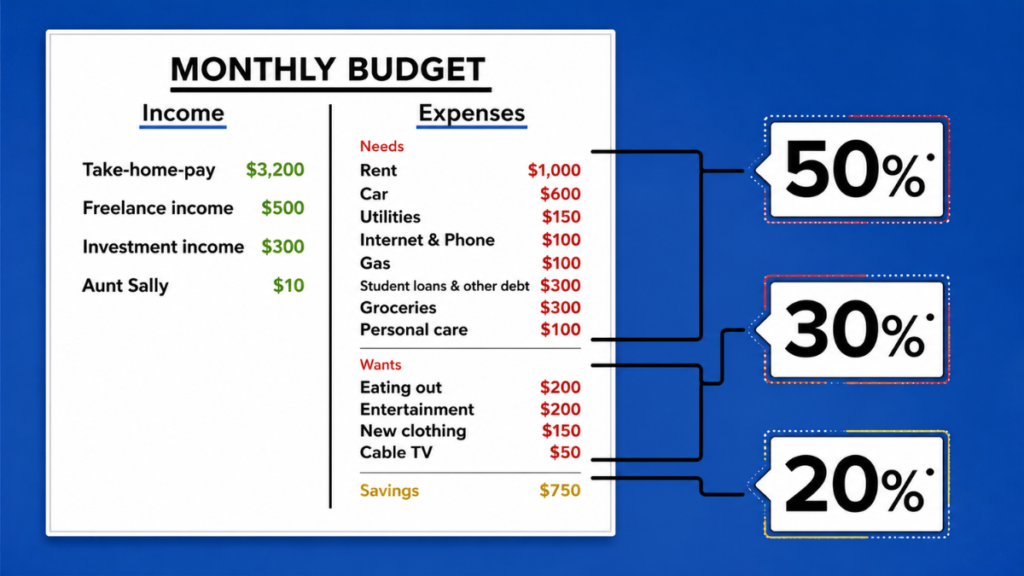
Here is how it works with real numbers. Say you earn $4,200 a month after tax. Your fixed costs come to $2,100 for rent, utilities, and insurance. Your variable spending adds up to $1,300 for groceries, transport, and other daily costs. A monthly budget calculator subtracts both from your income and shows you $800 left over. That $800 is your real savings capacity, not a guess.
Most people never calculate this number. They estimate it in their head, and they are usually wrong by a wide margin.
Why Guessing Your Budget Fails
Your brain is bad at tracking small, repeated purchases. A $6 coffee feels harmless in the moment. Thirty of them in a month equal $180, and most people never add that up. A monthly budget calculator forces the math you would otherwise skip.
This is not about willpower. It is about visibility. You cannot fix a spending pattern you cannot see clearly. Once the number is in front of you, the decision becomes obvious instead of emotional.
I have reviewed budgets for friends who swore they had no idea where their money went. In almost every case, the answer was hiding in small subscriptions or food delivery charges. The calculator did not judge them. It just showed the total.
What a Monthly Budget Calculator Actually Needs
A useful calculator needs three inputs. Skip any one of them and the output becomes unreliable.
Net income. Use your take-home pay, not your gross salary. Taxes and deductions never reach your bank account, so they should never appear in your budget.
Fixed expenses. These are costs that stay roughly the same every month. Rent, loan payments, insurance premiums, and subscriptions belong here. They rarely change without you actively canceling or renegotiating something.
Variable expenses. Groceries, fuel, entertainment, and eating out fall into this category. These numbers shift monthly, so use an average from your last two or three months of statements, not a single month.
Step-by-Step: Building Your Budget the Right Way
Follow this order every time. Skipping steps is the main reason budgets fall apart within a few weeks.
Step 1: Pull real transaction data. Open your bank and credit card statements from the past 60 days. Do not rely on memory. Memory consistently underestimates spending by 15% to 25%, based on patterns I have seen across dozens of personal budgets.
Step 2: Separate fixed and variable costs. List each expense under the correct category. This separation matters because fixed costs are hard to change quickly, while variable costs respond to small daily decisions.
Step 3: Enter the numbers into the calculator. Input net income, fixed expenses, and variable expenses as three separate totals. Most calculators, including the one on SavingsBeat, will instantly show your surplus or deficit.
Step 4: Review the result honestly. A negative number is not a failure. It is a starting point. It tells you exactly how much adjustment your spending needs, and in which category.
Step 5: Recalculate every payday. Your numbers shift with the season, with irregular bills, and with life changes. A budget calculated once in January is outdated by March.

A Second Example With Different Numbers
Consider someone earning $3,000 a month with $1,900 in fixed costs and $900 in variable spending. That leaves $200 in monthly surplus. Over a year, that $200 becomes $2,400 in savings, without touching a single investment account. The calculator makes this visible before the year starts, not after it is too late to adjust.
This is the real value of running the numbers early. You are not reacting to a shortfall. You are planning around a known outcome.
The One Mistake Almost Every Budget Calculator Misses
Most people forget irregular annual expenses. Car registration, annual subscriptions, holiday spending, and gifts do not appear every month, so they get left out entirely. Then one month arrives with an unexpected $600 bill, and the whole budget collapses.
The fix is simple. Take your total annual irregular costs and divide by 12. Add that monthly amount as its own line item, even in months when you are not spending it. This single adjustment prevents most mid-year budget failures, and almost no budgeting guide mentions it directly.
Common Budgeting Mistakes to Avoid
Using gross income instead of net income. This inflates your available cash and leads to overspending almost immediately.
Setting zero allowance for discretionary spending. A budget with no room for enjoyment rarely survives past the second week. Build in a realistic amount, even if it is small.
Updating the budget only once a year. Rent increases, new subscriptions, and salary changes all shift your numbers. Recalculate monthly to keep the budget accurate.
Ignoring small recurring charges. Streaming services, app subscriptions, and gym memberships add up quietly. Review your recurring charges every three months and cancel what you do not use.
Where a Monthly Budget Calculator Fits Into Your Bigger Financial Plan
A budget calculator is the starting point, not the finish line. Once you know your monthly surplus, you can direct it with purpose. Some of it can build an emergency fund. Some can go toward debt payoff. Some can move into a retirement account or a compound interest calculator to project long-term growth.
Without this first step, every other financial tool works with guesswork instead of real numbers. The budget calculator is what makes the rest of your financial plan accurate.
Final Takeaway
A monthly budget calculator gives you one clear number: how much you have left after covering your real costs. That number replaces guesswork with a fact you can act on immediately. Calculate it with real data, update it every payday, and use the surplus with intention instead of letting it disappear into small, unplanned purchases.