A raise percentage calculator turns a vague number into a real dollar figure. Your boss says “you’re getting a 3% raise,” and that sounds fine until you check what it actually adds to your paycheck. This matters more in 2026, because most raises are landing below inflation.

What a Raise Percentage Calculator Actually Shows You
A raise percentage calculator takes your current salary and your raise percentage, then gives you three things. It shows your new annual salary, the extra dollar amount per year, and the extra amount per paycheck. That last number is the one most people never see until payday.
Here’s a real example. Take a $52,000 salary with a 4% raise. That raise adds $2,080 a year, bringing the new salary to $54,080. Spread across 26 biweekly paychecks, that works out to about $80 more before taxes each pay period.
Run the same numbers through a savings calculator and you can see how that extra $80 per paycheck adds up if you set it aside instead of spending it. Most people never do this step. They see the raise, feel good about it, and let the extra money disappear into normal spending within a month or two.
The Average Raise Percentage in 2026
Employers are not being generous this year. Mercer’s 2026 survey put average merit raises at 3.2%, with total salary increases, including promotions and cost-of-living bumps, at 3.5%. Payscale’s separate forecast landed close by, at 3.5% average base pay growth.
That range has barely moved since 2025. State and local government workers did slightly better, averaging closer to 3.9%. If your raise falls between 3% and 4%, you are getting a normal raise, not a bad one and not a great one.
The real problem is inflation. According to the Bureau of Labor Statistics, CPI-U rose 4.2% for the twelve months ending May 2026. A 3.5% raise against 4.2% inflation means your paycheck grew, but your buying power still shrank slightly.
How to Calculate Your Raise Percentage by Hand
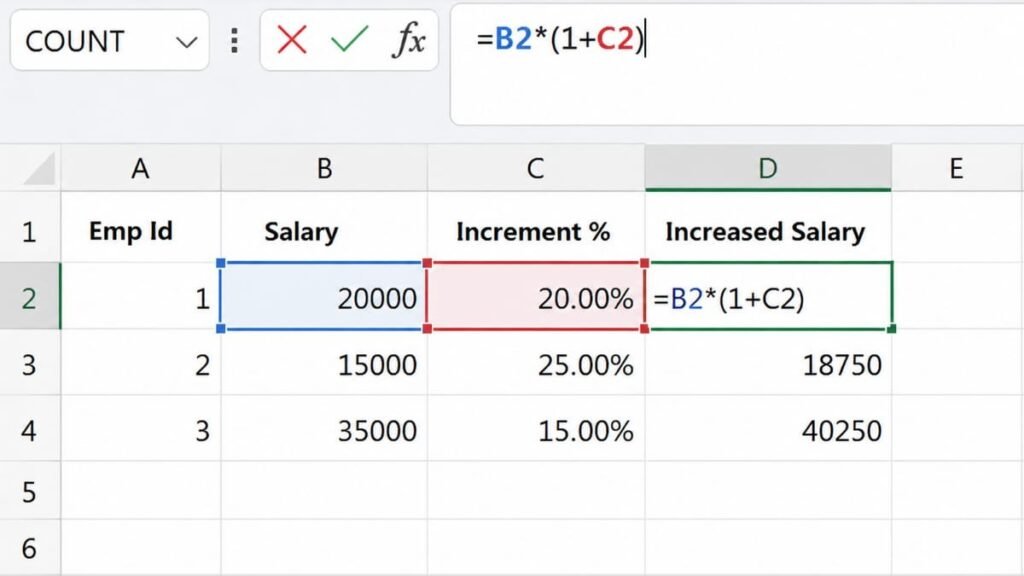
You don’t need a tool to check the math yourself. Subtract your old salary from your new salary. Divide that number by your old salary, then multiply by 100.
Say your salary moved from $48,000 to $49,920. Subtract to get $1,920. Divide $1,920 by $48,000, and you get 0.04. Multiply by 100, and your raise is 4%.
This same formula works for hourly pay. Just use your hourly rate instead of your annual salary, and the percentage comes out the same either way.
What Counts as a Good Raise Right Now
Context changes what “good” means. A 3.5% raise matches the average employer budget for 2026, but it still trails inflation. A 4.7% raise clears both inflation and the typical merit pool, and it usually goes to employees rated as exceeding expectations.
Promotions work differently. Mercer’s data shows average promotion raises running around 8.7% in 2026, well above a standard annual bump. If you moved into a new role with more responsibility and only got 4%, that gap is worth raising with your manager directly.
Anything below 2% barely registers once taxes come out. On a $50,000 salary, a 2% raise adds $1,000 a year, or roughly $38 per biweekly check. That number often gets absorbed by a single grocery run.
Why Your Raise Has to Beat Inflation, Not Just Feel Big
A raise that sounds large can still be a pay cut in real terms. If prices rise 4.2% and your raise is 3%, you can technically buy less than you could a year ago. This is the part a percentage on a pay stub never explains on its own.
Run your new salary through a budgeting tool before you make any spending changes. That way you can see whether your monthly costs actually grew faster than your paycheck did. Most people skip this check and assume a raise automatically means more breathing room.
Merit Raises vs Promotion Raises vs Cost-of-Living Adjustments
These three types get lumped together, but they mean different things. A merit raise rewards performance and typically runs 3% to 5%. A cost-of-living adjustment just tries to match inflation, so it should track close to that 4.2% CPI figure.
A promotion raise reflects a new job title and new duties, which is why it runs much higher, often 7% to 10%. If your raise came with new responsibilities but the percentage looks like a standard merit increase, you likely got underpaid for the change in scope.
Knowing which category your raise falls into changes how you should respond. A low merit raise might mean average performance in a tight budget year. A low promotion raise is a negotiation problem, not an economic one.
What to Do With the Extra Money From a Raise
Before you adjust your lifestyle, decide where the extra money goes. A 4% raise on $60,000 adds about $2,400 a year, which is real money if you direct it somewhere specific.
Pushing that amount into a retirement calculator shows how even a modest yearly increase in contributions compounds over decades. If you carry a loan, running the new numbers through an EMI calculator can show whether a slightly higher payment shortens your payoff timeline in a meaningful way.
The trap is treating a raise as free money. It isn’t. It’s the same salary structure with one variable changed, and every dollar of it still needs a job to do.
The Bottom Line
A raise percentage calculator turns a headline number into something you can actually act on. Check your dollar increase, compare it to the 3.5% average and the 4.2% inflation rate for 2026, and decide from there whether your raise is keeping pace or falling behind. If it’s below average, that’s useful information for your next conversation with your manager, not just a number to accept quietly.